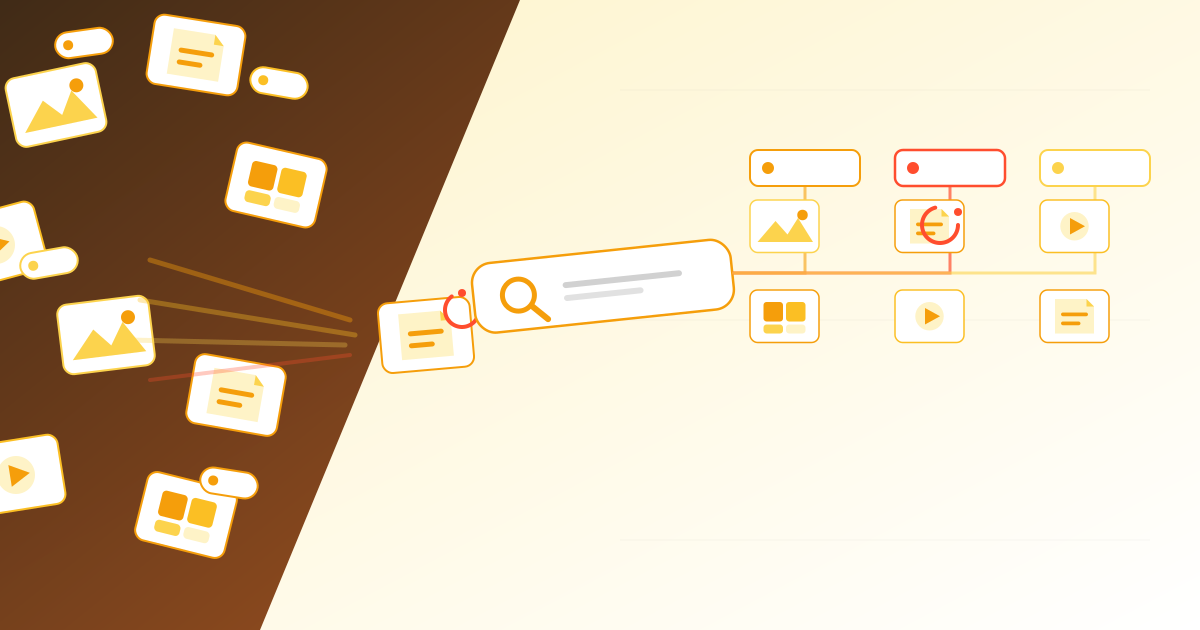
A taxonomy that scales across markets is a shared classification structure — categories, attributes, and controlled labels — that stays consistent at the global level. It allows regional variation in terminology so content remains findable and reportable across languages and business units. Without this dual structure, organizations end up with as many taxonomies as they have markets, each incompatible with the others, defeating the purpose of a central content repository.
Why Single-Market Taxonomies Break at Scale
Most taxonomies start as a convenience: one marketing team builds categories that match its own campaigns, product lines, and internal jargon. The structure works until a second region, a second language, or a second product division starts uploading assets into the same repository. At that point, synonyms multiply ("promo" vs. "campaign" vs. "offer"), hierarchies diverge (a region that organizes by product line vs. one that organizes by channel), and search quality collapses because the same concept is tagged five different ways. This is the structural problem a content supply chain has to solve before automation or AI tagging can add any value — garbage structure in, garbage retrieval out.
How to Design a Taxonomy Structure That Scales Across Markets
A taxonomy built to survive multiple markets separates what stays global from what can vary locally. In practice this means defining:
- A structural layer — the hierarchy of categories and facets (asset type, product line, campaign, usage right) that is identical everywhere, regardless of language or region.
- A controlled label layer — the actual terms within each category, which can be translated or regionally adapted but must map back to a single canonical ID.
- A synonym/alias layer — regional or departmental terms that resolve to the same canonical label, so a search for “offer” in one market and “promo” in another returns the same assets.
- A governance layer — the rules, owners, and workflows that decide who can add, rename, merge, or retire a term.
This separation is what allows a French product team and a Japanese regional team to use terminology that feels native to them while still rolling up into the same global reporting structure. For teams building this out in detail, the practical steps for defining attributes and controlled vocabularies are covered in How to Build a Metadata Strategy for Your DAM.
Governance Model: Owners, Stewards, and Workflows
Structure alone does not prevent drift — governance does. According to OvalEdge’s 2026 comparison of taxonomy management tools, effective taxonomy governance depends on named owners and stewards, defined permissions, review workflows, approvals, and audit trails, anchored by a shared glossary that aligns how terms are defined across teams. The same source notes that platforms like Collibra apply this model through a business glossary and a broader data-governance environment, letting organizations structure terms, define relationships between them, and run configurable approval processes.
Applied to a multi-market content taxonomy, this translates into three concrete roles:
- A global taxonomy owner, usually sitting in brand or content operations, who approves any change to the structural layer.
- Regional stewards, who can propose new local labels or synonyms but cannot restructure categories unilaterally.
- An audit trail, so any renamed, merged, or deprecated term is traceable — essential when a taxonomy change silently breaks search or reporting in a region that wasn’t consulted.
Multilingual Label Management vs. Structural Taxonomy
One of the most common governance failures is treating translation as a taxonomy problem rather than a label problem. Translating a category name into German does not create a new category — it creates a localized label for the same canonical structural node. Confusing the two is how organizations end up with duplicate hierarchies that drift apart over time, each maintained independently by a different region. The fix is mechanical: every local label, in every language, must carry a reference back to one canonical ID, and that mapping should live in the governance layer, not be re-created ad hoc by whichever team touches the repository first.
Vendor Approaches to Multi-Market Taxonomy Governance
Most enterprise DAM and content platforms now offer some form of structured metadata governance, though the depth of multi-region, multi-language support varies. The table below lists vendors in alphabetical order, not by preference or capability ranking.
| Vendor | Multi-market taxonomy approach |
|---|---|
| Acquia DAM | Metadata schemas with configurable taxonomy trees, administered centrally with role-based editing permissions. |
| Adobe AEM Assets | Tag-based metadata model integrated with Experience Manager’s broader content hierarchy, supporting localized tag sets. |
| Aprimo | Centralized taxonomy management tied to workflow and rights data, with governance controls on who can edit controlled vocabularies. |
| Bynder | Metadata framework with configurable fields and asset workflows, allowing regional teams to apply local labels within a shared structure. |
| Cloudinary | Structured metadata and tagging applied largely through API-driven workflows, suited to teams with engineering resources to manage taxonomy logic. |
| Frontify | Brand-centric metadata tied closely to brand guideline structures, with taxonomy typically scoped at the brand or sub-brand level. |
| Lyvio by Wedia | Taxonomy rules and brand-compliance checks are embedded directly into the platform’s Smart Library and Brand Control components rather than configured as a separate add-on layer. |
| Orange Logic | Highly configurable metadata schema editor aimed at complex, multi-collection environments such as museums and large media libraries. |
No single vendor eliminates the need for an organization to define its own canonical structure first — the platform enforces the governance rules a team designs, it does not design them automatically.
A Practical Rollout Sequence
Scaling a taxonomy across markets works better as a sequence than as a single project:
- Audit existing tags across every market and system currently in use, without judging them yet.
- Define the canonical structural layer with a small cross-regional working group, not a single headquarters team.
- Map existing regional terms to canonical IDs as synonyms, rather than deleting them outright.
- Assign stewards per region with clearly scoped editing rights.
- Pilot in two markets with different languages before a full rollout, to surface translation and hierarchy conflicts early.
- Set a review cadence — typically annual for structure, quarterly for local labels — so the taxonomy evolves without fragmenting again.
A taxonomy is never “finished”; it is a governed, living structure. Once a content supply chain has reliable classification in place, the organization can start measuring which assets and categories actually perform, a topic covered in Content Scoring and Performance Analytics: A Growing Role.
Markets will keep adding new products, campaigns, and regional terminology faster than any single team can police manually. The governance model — not the taxonomy diagram itself — is what determines whether that growth stays organized or collapses back into the fragmentation the organization started with.
Source:OvalEdge