MACH architecture — Microservices, API-first, Cloud-native, and Headless — is the composable infrastructure pattern now shaping how enterprises evaluate Digital Asset Management platforms. Rather than buying a single all-in-one DAM suite, composable DAM lets organizations assemble best-of-breed modules for storage, metadata governance, and AI-driven creative automation, connected through APIs instead of locked inside one vendor’s monolith. The clearest adoption signal in 2025-2026 is that the organization defining this standard, the MACH Alliance, is itself pivoting from “composable commerce stewardship” toward what it calls “agentic ecosystem orchestration” — a sign that AI agents, not just API connectivity, are becoming the real test of a composable stack.
What MACH Architecture Actually Means for a DAM Stack
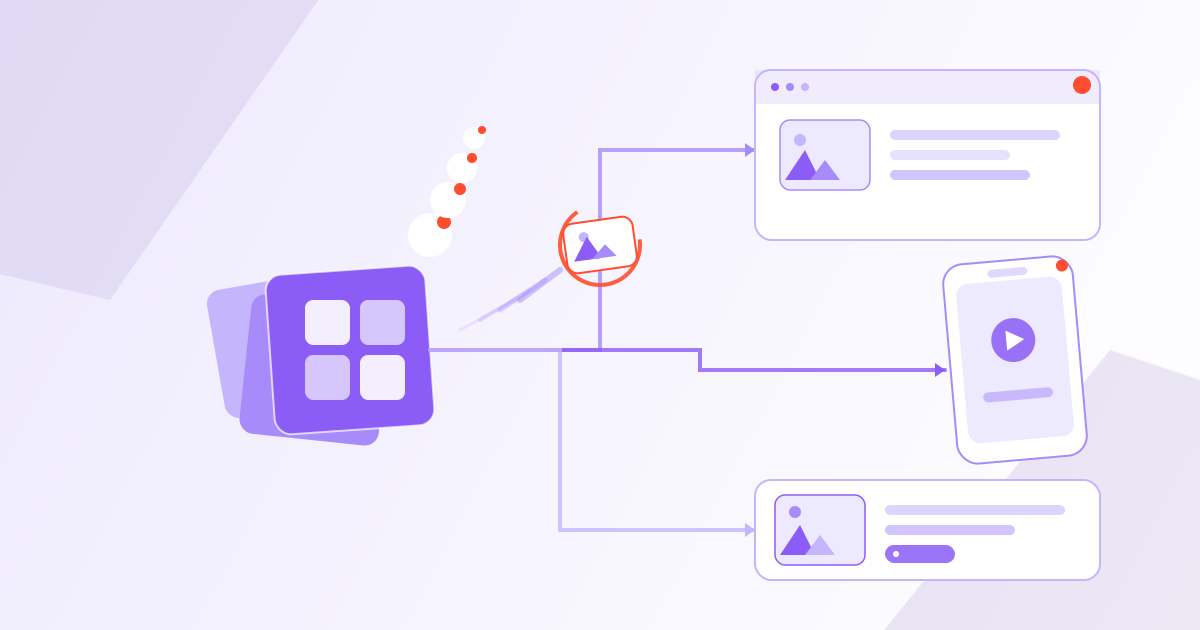
A MACH-aligned DAM separates four concerns that legacy platforms historically bundled together: the microservices layer (independent, deployable asset-processing functions), the API-first layer (every capability exposed for integration), the cloud-native layer (elastic infrastructure rather than fixed on-premise capacity), and the headless layer (asset delivery decoupled from any single front-end). In practice, this means a brand could swap its metadata-tagging engine or its rendition-delivery CDN without re-platforming the entire asset library. This matters increasingly because the modules being swapped in are no longer just storage or transformation services — they are AI models.
The Market Signal: MACH Alliance Pivots to Agentic Ecosystems
The strongest adoption signal of 2025 came directly from the MACH Alliance’s own governance changes. Under new leadership appointed in September 2025, the Alliance publicly described its transition as moving “from composable commerce stewardship to agentic ecosystem orchestration,” according to its own announcement on machalliance.org. The same month, the Alliance launched a “MACH Architect” certification program open to practitioners beyond its member vendors, citing “growing MACH adoption in the AI era” as the driver.
By December 2025, the Alliance reported ending the year with more than 100 member organizations — its largest cohort to date — alongside the launch of an “Open Data Model” and a “MACH AI Exchange,” according to the MACH Alliance’s year-end release. The Alliance also referenced research claiming organizations with a composable foundation achieve AI ROI at a notably higher multiple than those without one; that specific figure comes from the Alliance’s own research arm and has not been independently verified against a public methodology, so it should be treated as a vendor-association claim rather than a neutral benchmark.
Why Composability Matters More Once AI Agents Enter the Stack
A composable architecture becomes operationally relevant the moment an organization wants to plug in, test, or replace an AI model without disrupting the rest of its content supply chain. According to analysis from Amplience referencing Gartner’s commerce forecasts, by 2027 at least 60% of new cloud-based B2C and B2B digital commerce solutions are expected to align with MACH principles — a figure worth treating as a secondary citation of a Gartner forecast rather than a Gartner-published number itself, since it was relayed by a vendor rather than sourced directly from Gartner. Whatever the precise percentage, the directional signal is consistent with what the MACH Alliance’s own 2025 governance shift shows: composability is increasingly justified by AI agent flexibility, not API connectivity alone.
For teams evaluating AI-native platforms specifically, our AI-Native DAM: The Complete Guide covers how generative and agentic capabilities are being embedded directly into asset management, and AI Agents in DAM: Real vs Hype in 2026 separates genuine agentic orchestration from marketing language currently circulating in the category.
Market Growth and the Analyst Reclassification
The broader DAM market is expanding fast enough to pull architectural debates with it. According to MarketsandMarkets, the digital asset management market is projected to reach USD 14.51 billion by 2031, up from USD 6.23 billion in 2025, a compound annual growth rate of 15.4%. That growth has coincided with analysts tightening their definition of what counts as a true DAM platform: Gartner’s 2025 Magic Quadrant excluded Canto for failing to meet its platform definition, while admitting new entrants including Wedia, Frontify, and PhotoShelter, according to a Gartner Magic Quadrant vendor-movements summary. Only 15 vendors made the 2025 shortlist globally, per Fotoware’s own account of its inclusion.
| Vendor | Gartner MQ 2025 | Forrester Wave Q1 2026 |
|---|---|---|
| Acquia (Widen) | Challenger | — |
| Adobe (AEM Assets) | Leader | Leader |
| Aprimo | Leader (2nd consecutive year) | Leader |
| Bynder | — | Leader |
| Canto | Excluded (doesn’t meet DAM definition) | — |
| Fotoware | Recognized entrant | Niche Player |
| Frontify | Challenger | — |
| Hyland (Nuxeo) | Challenger | — |
| OpenText | — | Leader |
| Orange Logic | Leader | Leader |
| Wedia | Niche Player (new entrant) | Niche Player |
Wedia’s appearance as a newly added Niche Player in Gartner’s 2025 report, repeated in Forrester’s Q1 2026 Wave, illustrates a pattern common to recently evaluated vendors: inclusion in an analyst report and placement in its top tier are two separate milestones, and both carry weight for buyers assessing a vendor’s maturity in a composable, API-first context. For a broader look at how analyst-recognized platforms stack up on AI-native criteria specifically, see our criteria-based shortlist of AI-native DAM platforms.
Where This Leaves Buyers Evaluating Composable DAM
The practical takeaway for a technical buyer is that “MACH-compliant” is no longer the finish line it was when the term was coined for composable commerce. The MACH Alliance’s own strategic pivot toward agentic orchestration, combined with Gartner’s tightened platform definition and a market growing at 15.4% CAGR, suggests the next wave of DAM evaluation criteria will weigh how well a platform’s API layer supports swappable AI agents, not just swappable front-ends. Procurement checklists built purely around headless delivery or microservices decomposition risk missing the capability that is now driving most of the architectural conversation.
Source:MACH Alliance