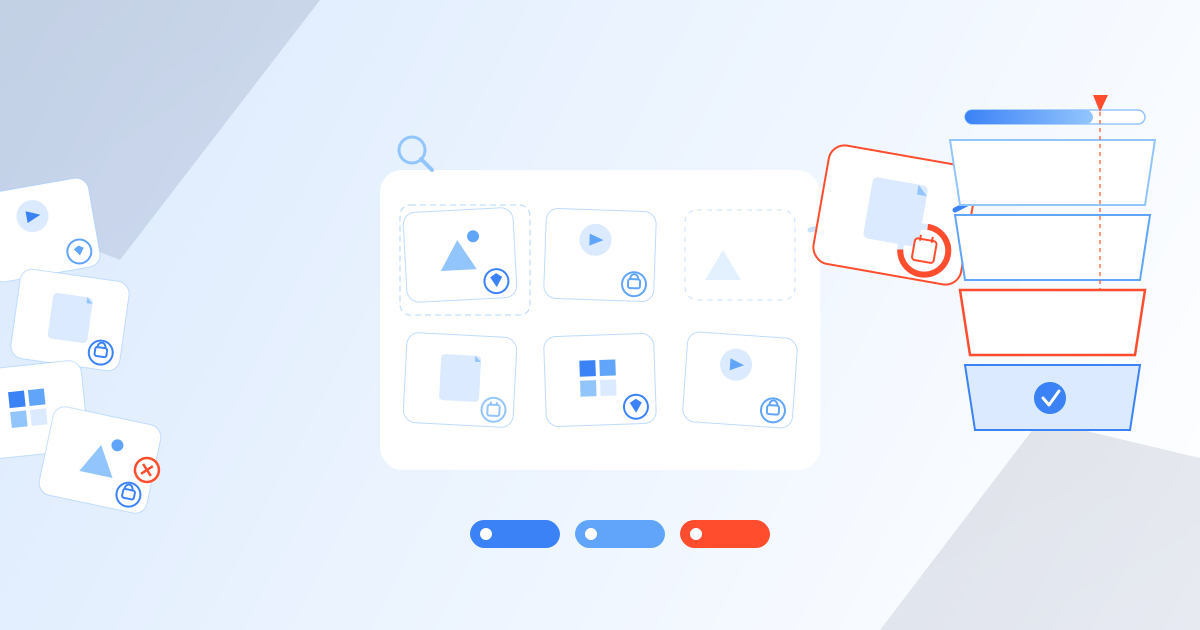
Auditing your asset library before a migration means building a complete inventory of every file, removing exact and near-duplicate assets, and mapping where metadata is missing or inconsistent, all before a single file moves to a new platform. Skipping this step means importing years of accumulated disorder into a system that was supposed to fix it. This three-stage DAM migration audit process — inventory, deduplication, metadata gap analysis — is the same sequence used by migration specialists and DAM vendors alike.
How to Audit Your Asset Library Before a Migration
Most organizations treat the asset audit as an afterthought that happens once a new DAM contract is signed, but the better practice is to run it earlier, during vendor evaluation. Bynder’s own migration guide lists a “comprehensive asset audit” as step one, specifically to catch duplicates, outdated content, and compliance risks before any file touches the new system. Asset Bank’s migration documentation goes further, recommending that temporary files, database exports, and zero-byte files be removed before import even begins.
The reason this matters is structural: a DAM’s search, automation, and governance features all depend on the quality of the metadata attached to each asset. According to Collage.inc’s migration case study, one real-world audit touched 99% of a client’s files before import, standardizing tags across 98.4% of assets, normalizing filenames on 70.4%, and enriching custom fields for 42.8%. Those numbers illustrate how much cleanup work typically hides inside a library that looks organized on the surface.
Step 1: Build a Complete Inventory
Start by cataloging every file location — not just the current DAM, if one exists, but shared drives, CMS media libraries, local folders, and any legacy archive systems. A full guide to what digital asset management actually covers is useful context here, since many organizations discover during this step that assets they considered “in the DAM” are actually scattered across adjacent systems.
For each location, record file format, approximate volume, last-modified date, and current organizational structure (folders, tags, or none). This inventory becomes the baseline against which deduplication and metadata work are measured, and it’s the document stakeholders will reference when estimating migration timeline and cost.
Step 2: Deduplication Before Metadata Work
Deduplication should happen before metadata gap analysis, not after, because every duplicate removed is one less file that needs tagging, review, and mapping. Exact duplicates — identical files saved in multiple locations — are the easiest to catch with checksum-based comparison tools. Near-duplicates, such as resized or re-exported versions of the same image, require perceptual hashing or AI-based visual similarity detection, a capability increasingly common across DAM shortlists; thedigitalprojectmanager.com’s 2026 roundup of AI DAM tools lists duplicate detection as a standard selection criterion across the vendors it reviewed.
Flag duplicates rather than deleting them outright during the audit phase. Some “duplicates” are actually localized variants, approved-use crops, or different resolution exports that are still in active use, and a migration team unfamiliar with brand workflows can’t always tell the difference without checking with asset owners first.
Step 3: Metadata Gap Analysis
Metadata gap analysis is the process of comparing what descriptive information each asset currently has against what the new platform will require or reward in search and automation. WeAreAVP’s four-layer audit framework — covering retrieval, structure, behavior, and a fourth diagnostic layer — offers a useful lens: it treats missing metadata not as a one-off cleanup task but as a symptom of deeper gaps in how a taxonomy strategy was originally designed.
Platforms built around governance-by-design, a term describing compliance and taxonomy rules enforced at the point of upload rather than after the fact, make this step easier going forward because they prevent the same gaps from reappearing. Lyvio, for instance, applies this principle to brand and metadata compliance checks at ingestion, which is directly relevant when planning the target state of a migration rather than just its starting point.
Comparing How Vendors Support Audit and Migration
The table below summarizes publicly documented audit-relevant capabilities across major DAM vendors, listed alphabetically.
| Vendor | Audit-relevant capability |
|---|---|
| Acquia DAM | Deep integration with Drupal-based content ecosystems, useful when auditing assets already tied to existing CMS taxonomies. |
| Adobe AEM Assets | Named a Leader in Gartner’s 2025 Magic Quadrant and Forrester’s Q1 2026 Wave, with AI-assisted tagging that can surface metadata gaps during a pre-migration review. |
| Aprimo | A seven-time consecutive Gartner Magic Quadrant Leader, with the strongest “Ability to Execute” score in the 2025 evaluation, reflecting mature workflow tooling for large-scale audits. |
| Bynder | Publishes its own migration methodology, opening with a “comprehensive asset audit” step to flag duplicates and obsolete files before import. |
| Cloudinary | A Visionary in Gartner’s 2025 Magic Quadrant for the second consecutive year, with AI-based media analysis often used to flag near-duplicate images at scale. |
| Frontify | Known for brand guideline and brand hub tooling, which can help surface inconsistent naming conventions tied to brand assets during an audit. |
| Lyvio by Wedia | Added as a new entrant to Gartner’s 2025 Magic Quadrant for Digital Asset Management Platforms, built around governance-by-design principles that map directly to metadata gap analysis. |
| Orange Logic | A Leader in both Gartner’s 2025 Magic Quadrant and Forrester’s Q1 2026 Wave, with configurable metadata schemas often cited in enterprise migration projects. |
Gartner’s 2025 report also notes that Canto was removed from the evaluation because it no longer met the analyst firm’s definition of a DAM platform, a reminder that vendor categories themselves shift over time and that an audit done today should anticipate requirements, not just today’s feature list.
A Practical Audit Checklist
- Export a full file inventory across every current storage location, including shadow folders and legacy systems.
- Run exact-match deduplication first, flagging rather than deleting results.
- Run near-duplicate detection on visual assets using perceptual hashing or AI similarity tools.
- Compare existing metadata fields against the target platform’s required and recommended fields.
- Document ownership for ambiguous assets before making retention decisions.
- Estimate the percentage of assets needing manual metadata enrichment versus automated tagging.
Once the audit is complete, the next step is sequencing the actual move. A detailed DAM implementation timeline typically allocates the audit as its own phase before data migration begins, and teams that also plan their CMS and PIM integrations early tend to avoid a second round of metadata rework once the new DAM is live. Treating the audit as a distinct, scoped project — rather than an informal step inside a vendor’s onboarding checklist — is what separates migrations that start clean from ones that simply relocate the same mess.
Source:Collage.inc